Teaching Movement for Actors and Authentic Living
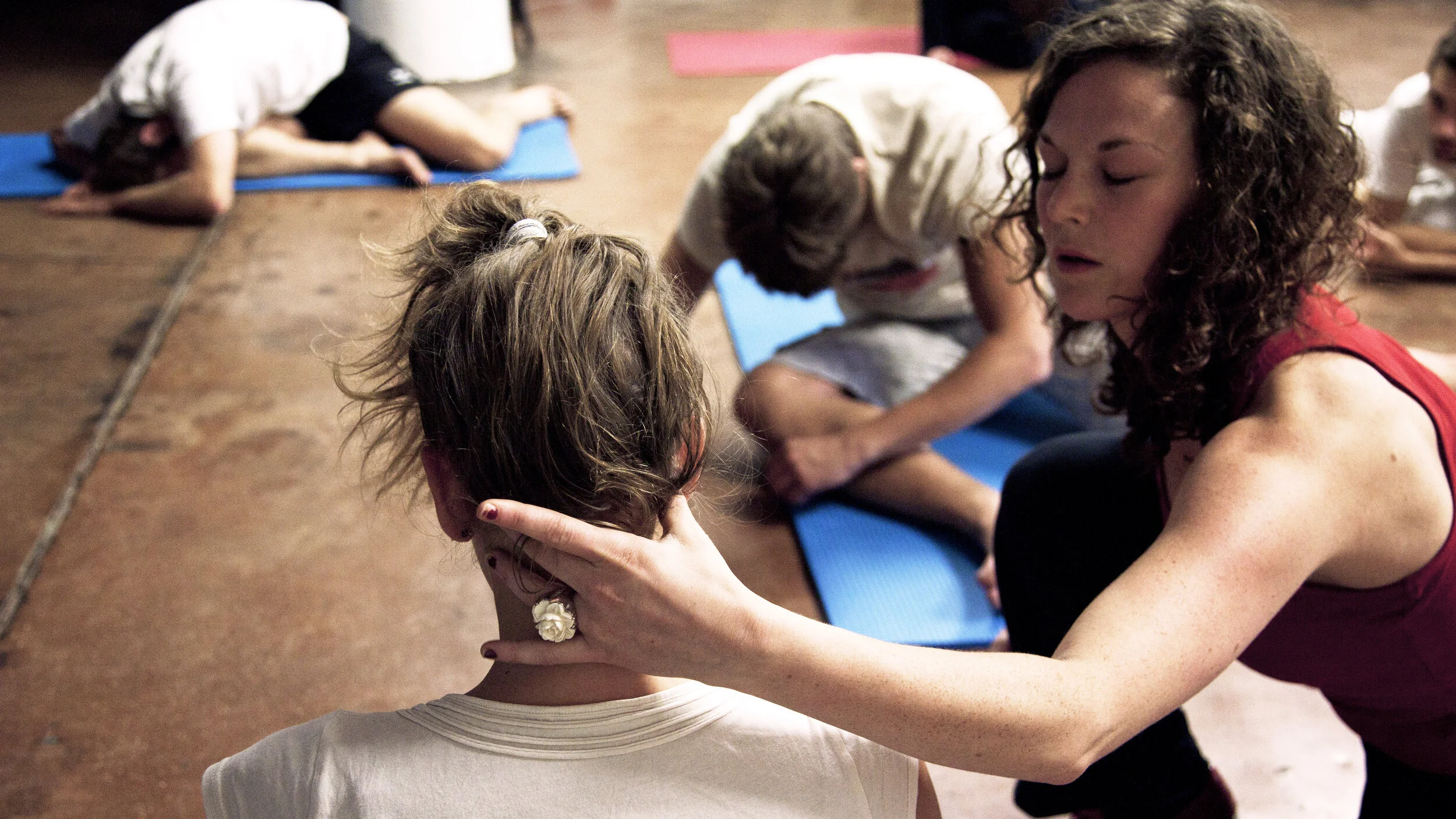
An actor requires unique movement training. In my classes, we explore the difference between dance and movement. Most students assume that a movement class is essentially a dance class. These forms intersect, but movement extends beyond dance to include our behavior. We are constantly moving, and the subtle details of our posture and especially our breath convey the reality of the actor’s inner experience. Dance has many forms that vary widely. Ballet is very different from belly dance, and in both disciplines, students study rigorously to create shapes and forms that correlate with each style.
The actor’s body must be free to respond spontaneously, like a child on a playground. As we go through our lives, we develop patterns of physical tension that keep us from acting on our impulses. While this is an essential part of socialization, these holding patterns need to be released to allow the truth of our inner experience. In Level 1, students focus on learning their patterns, where they hold physical tension and the beliefs that restrict them from expressing themselves truthfully.
So, if movement is not dance, what is it? Through discussion and inquiry, we discover that movement is a process of change. As we move, a transformation occurs, and our relationship to weight, space, and time evolves. The word transformation breaks down to mean “moving across shapes.” We discover that movement creates life; life is constantly moving and changing. The ebb and flow of our breath creates expansion and release in our torso. Breath is key to creating realistic behavior for the stage and screen. The actor’s job is to create a realistic emotional life and behavior for the audience, which requires a release and spontaneous breath rather than restricted and controlled.
Breath
It is the breath that moves energy. It is through breath that we bring fresh energy into the body. With each exhale, we have the opportunity to release old and stagnated energy. Because all life flows on the breath, when we experience heightened and uncomfortable emotions, we can control our breath by contracting the diaphragm to suppress those feelings. These habits do not serve the actor and must be repatterned. I encourage my students to think of the quality of their breath as directly related to the quality of life in their acting. Deep and expansive experiences require deep and expansive breaths.
When we encounter unpleasant stimuli, the body instinctively blocks unwanted experiences by holding our breath. Perhaps it is a revolting smell on the street or an employer's ranting tirade. Holding and controlling our breath helps us regulate our emotions. Emotional regulation is vital in our personal lives and in maintaining social order and cohesion. Still, in our acting, we need to live on our impulses without censoring or editing ourselves.
We do a lot of work exploring three-dimensional breath in the torso and allowing our movement and impulse to originate from breath. However, a deep, controlled breath will not create the spontaneous behavior the actor seeks. We must learn to free our breath. By accessing a spontaneous breath, we permit ourselves to access behavior that is not premeditated but an instantaneous response to the moment.
The diaphragm is a thin muscle between the abdomen from the chest. When you inhale, the diaphragm creates a vacuum that pulls air into the lungs. The motion of your breath massages the intestines and liver. When you exhale, the diaphragm releases and air falls out of the lungs. The phrenic nerve controls the diaphragm's movement, sensation, and innervation. The phrenic nerve originates in the neck's cervical spine and runs alongside the lungs to the central tendon of the diaphragm. A light stretch in the front of the neck along the phrenic nerve can help release the diaphragm.
Vital organs surround the diaphragm. In Traditional Chinese Medicine, our vital organs create and hold our emotions. The diaphragm is how we can manipulate, control or suppress our emotions through contraction. All energy meridians run through the diaphragm. It is our main tool for emotional regulation. Actors need breath and emotion that is free, released, expansive, and spontaneous. We use breath, motion, sound, and contact exercises to undo patterns of control and restriction within the diaphragm.
The Chakra System
The Chakra System is handed down to us by the ancient Hindu and Vedic traditions. Yoga is one of the most popular forms of exercise in the United States. Yet, very few practitioners are aware of the wealth of self-knowledge available to them through yogic philosophy. Chakras are vortexes of energy throughout the body. Seven main chakras align the spine, from the base to the crown of the head, and align the major nerve plexes. Prana is the vital life force that moves through these vortexes and keeps us vibrant, healthy, and alive. The Sanskrit word Chakra translates to "wheel "or "disk". Each of the seven main chakras correlates to bundles of nerves, major organs, and different psychological, emotional, physical, mental, and spiritual states of being.
The natural state of energy is to move. If there is a blockage, energy cannot flow. Think of a beautiful spring brook. Because the water is moving, it remains clear. The same principles apply to Human Energy. Our chakra system acts as a bridge between the Inner and Outer worlds. Walking this Rainbow Bridge, we begin to understand the deep integrations of psychology, spirituality, and physicality.
We can use this system to bring all dimensions of Self into Alignment. In Level 1, we use the chakras as a road map to explore different parts of ourselves. We explore the vortexes with visualization, somatic movement, breath, and meditation. As students move through the chakra system, they encounter their blocks and are given the tools and skills to move through them.
Traditional Chinese Medicine
In Traditional Chinese Medicine, natural patterns of creation and destruction of five elements are observed. Our bodies are governed by the same cycles of nature and elemental interactions that create the functioning of vital organs that sustain life. The ancients understood individuals as inextricably connected to the whole and that these elements interact within our bodies just as they do in nature. These elements correspond to the seasons, organs and their related functions, emotions, and energy meridians. An observable example is the cycle of the seasons, which reflects the hormonal cycle of menstruation. We are in the follicular phase in spring, ovulate in summer, shed in the fall, and bleed in the winter. Our lifeline follows a similar cycle.
We observe water generating and feeding new growth, such as wood sprouting green and fresh in the spring. The same wood dries and sparks fire in the summer heat. Fire turns wood to ash and returns vital minerals to the soil, replenishing the earth. Earth transmutes these minerals into metals and stones of all kinds. Metal holds the cutting energy of grief and the weight of separation, just as the fall pulls the leaves from the trees. Over time and with the eroding force of waves, minerals return to the water, fueling all life on this planet.
In Traditional Chinese Medicine, the same pattern is observed in emotional cycles. When we experience fear, we may become frozen. Still, activating the adrenals, fear springs us into fight or flight and gives us the necessary energy to defend ourselves, communicate our needs and boundaries, and vocalize our dissent and sacred “No.” When our needs are met and boundaries respected, we can feel authentic love, joy, and connection. Once we open ourselves to loving and connecting with someone deeply, we care for and worry about them. And in the end, everything we love, we will eventually lose. We do not get to keep anything in this life, and the cold-cutting separation of grief is something we will all experience in this life. In moments of significant loss, we can feel frozen in the fear that we will feel the pain of grief forever, but if we allow the cycle to keep moving, we will access our anger, an essential part of the grieving process, which brings us around to joy and connection again.
I use the elemental phase frame to help students understand emotions’ flowing nature and utility. Understanding that emotional states ebb and flow makes students feel safer riding the waves. Learning that all emotions have utility helps students move beyond judgments and blocks they may have around particular emotional expressions.
The Williamson Technique
The Williamson Technique is the foundation of my curriculum. It cultivates the development of a creative inner life, imagination, and emotional and sensorial connection to the imaginary world. Loyd Williamson is a celebrated movement specialist, actor, creator, and teacher. During his work with Sanford Meisner in the early 1970s, Loyd was inspired to develop a physical training technique to accompany Sanford Meisner's acting technique. His technique focuses on freeing the actor's impulse and releasing habitual physical patterns of tension. He was devoted to training the body and voice to be vulnerable, viscerally connected, and responsive to imaginary circumstances. Through Level 1 and 2 we explore the Physical Process of Acting, opening the channel, and deepening our connection to the senses. Loyd Williamson has taught his technique at the Juilliard School of Drama, New York University, Rutgers University, HB Studio, Northern Illinois University, Ensemble Studio Theater, Pearl Theater Company, and Princeton. Recently, Loyd Williamson received a lifetime achievement award from the Association of Theatre Movement Educators. The Williamson Technique offers the foundational physical training that every actor needs: freedom of expression, deep and released breath, physical balance, alignment, and rich vibration of sound.